Whom doth virtue feed?
Thoughts on an old Balachander film that still speaks to me

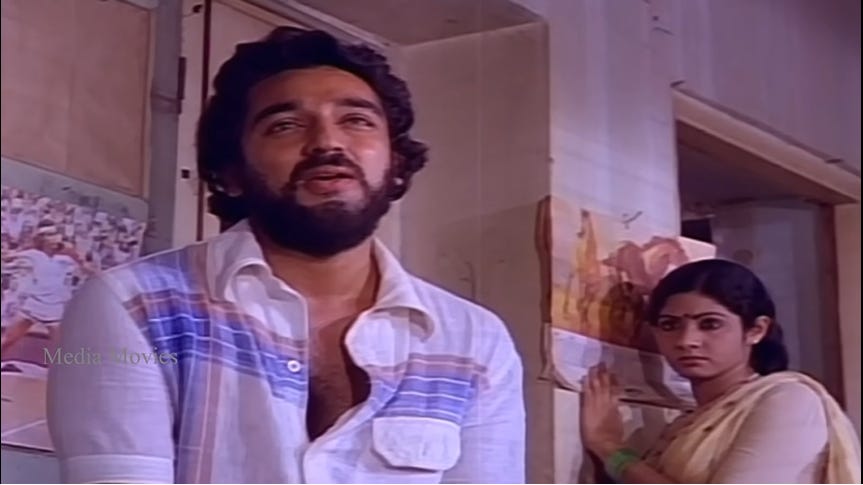
For a generation that watched films on Doordarshan and listened to their songs on Vividh Bharati or Radio Ceylon, my parents were probably led into loving the songs they loved because of watching the films first where they often formed part of the narrative - a distinctive feature of mainstream Indian films.
I, on the other hand, had Spotify for listening and YouTube/Internet Archive for watching. And being strapped for time to watch full-length films, I have often savoured soundtracks before being led - seduced - into watching the films. Many of the films I adore were discovered by me this way: Roja, Nayakan, Delhi-6, Umrao Jaan, to throw some names off my head. A film that figures prominently in this list of movies-I-was-seduced-into-watching-by-their-songs is K. Balachander’s Varumayin Niram Sivappu (1980). (The reader who understands Tamil and has not watched the film is strongly encouraged to do so before reading further. You will find it with ease on YouTube.)
The title, when translated from Tamil, reads: The Colour of Poverty is Red. No, that’s a bad translation. A whole sentence. Preposterous. Red the Colour of Poverty. Now, that seems a teensy bit more tolerable.
The film is the tale of Rangan (Kamal Hasan), an MA in Philosophy, who migrates to Delhi after bitterly quarrelling with his father, and struggles to find employment only to realise that an MA is the last thing that can save him from destitution. When we first meet Rangan, he is living with a roommate (who remains curiously unnamed) in a small one-room house which looks like a shack. These two denizens of empty pockets welcome a third newcomer - Thambu is his name - to their shared room of endless hopes and schemes to scrape off a meagre existence.
Our newcomer’s first experience of solidarity in his new home is highly telling, so far as the theme of the film goes. Thambu announces that he needs to have a bath and pulls out a fresh pair of trousers for change. No sooner than he does it, Rangan emerges from the bathroom, freshly bathed and wrapped in a towel and takes the trousers, looks at them admiringly (“Aah, it is almost as if my own father took my measurements and got this tailored”) and puts them on. Thambu registers a protest of personal ownership and is silenced by a very worldly-wise sounding remark from Rangan: “If you wish to survive here, there is nothing like yours or mine.”
Thus Balachander drops his first hint as to what he is getting at. Well, one amongst the several things that he is getting at in this film.
No private ownership. This seems to be the ethos of these chronically unemployed (+ educated) young men. They share their misery and hunger. And share their prosperity, which often translates into scavenging not-so-spent cigarette-butts from the streets and smoking them by taking turns.
Around 20 minutes into the film, Rangan has already made acquaintance with Devi (portrayed by Sridevi), a young woman making her living as an actress in stage-plays and leading an equally tormented existence with a father who is a compulsive gambler. Then, in a scathing scene, Rangan revisits Devi asking for a “passport-sized photograph” which he thinks he misplaced when he barged into her flat the day before (he was in hot pursuit of Devi’s father who had fleeced him of Rs.15 on a false pretext). Devi says that she just swept the floor dumped all the garbage.
But Rangan certainly cannot afford to get another copy of his photograph. He rummages through the building’s garbage bin. When Devi, who looks on, finally tells him that it is not worth the effort, he waves her off saying, “Oh, I have barely searched. If one searches deeper into the bin, one might even find Socialism.”
There is it. The film, then, is meant to be a satire on Socialist India during the rule of Indira Gandhi. Of course, Balachander isn’t the only Tamil director to take on Mrs. Gandhi’s ill-bethought populism. Cho Ramaswamy’s 1971 satire-film Muhammad Bin Tughluq delivered a particularly bold diatribe at Indira. But Balachander explores the bleakness of a stagnant socialist economy through the lives of the frustrated, starving youth. Politicians, bureaucrats and even the police never enter the frames.
In fact, the only scene that comes anywhere near politics (as generally understood) is the one where the three roommates are shouting sarcasm-laden slogans hailing the Congress Party:
“Congress (I) zindabad!”
“Congress (X) zindabad!”
“Congress (Y) zindabad!”
“Congress (Z) zindabad!”
At this point, Rangan’s unnamed roommate cries, with a zestful and seemingly hopeful voice, “Elections!”. But he receives only silence from his comrades.
But socialism cannot bear the entire blame of the piteous straits where Rangan finds himself. In his repeated failures to find employment, Rangan has to confront not only a hobbling economy but also the urge to act against his conscience. And our Bharathiyar-quoting philosophy post-graduate has a particularly tricky conscience, to say the least.
When his roommates arrange [through their (morally dubious) ingenuity] for a set of good clothes for him to attend an interview, Rangan reluctantly agrees. But at the interview, he faces questions completely irrelevant to the job profile. He says exactly this to his interviewers, on their faces. In a matter of seconds, the heated exchange becomes almost acrimonious with Rangan tearing up his degree certificates in rage, shouting “Bureaucracy, down down! Nepotism, down down! Favouritism down down! Red-tapism down down!” While Rangan may have had a point when he predicts to his friends beforehand that the interview is a mere eyewash and that the favoured candidate has already been selected, he undoubtedly ruins his chances because of his indomitably sensitive conscience and extreme outspokenness, not to speak of his temper.
There are two instances shown to us where Rangan feels compelled to quit his job and the viewer, by now familiar with his temperament, sympathises with his decisions. In the first one, he has taken up a job as a tutor to a young lady who seems sexually attracted to him and even makes physical advances. Rangan is shown to ignore her till he can endure no more and finally strikes her. In another instance, much later into the film, Rangan has found a job as a driver to a Tamil couple who are unaware that he can understand their language. The husband, a contractor, sends his wife to offer sexual favours to a company executive to win the contract. While returning home in their car, the wife narrates her success with a sigh of relief (“Oh, what a beast of a man he was”). Rangan hits the brakes with a violent suddenness and storms out of the car.
One begins to wonder if there is any job at all that is worthy of this man. Is he giving an undue place in his life to virtues that must necessarily be forsaken in some measure to live and feed oneself? Devi is more pragmatic. She holds on to her job as a theatre actress even though her employer Pratap, who writes and directs the plays, is obsessively (and possessively) attracted to her. Rangan is indignant at Pratap’s inappropriate conduct but Devi simply says:
“This is all too common in this profession.”
“Then why such a profession?”, asks an outraged Rangan.
“Don’t we need to eat?”
And Rangan realises later that virtues cannot feed him. Yet, he refuses to eat the bread of immorality. By now practically destitute, he is shown drinking water from wayside taps, pulling a rotten apple out of the mud, and ultimately fainting on the road. However, towards the end of the film, Rangan has finally secured a job that he has no qualms against: that of a barber. His father coincidentally visits the same shop where he works and in a moving scene, he explains his decision to his father. This, at last, is a profession where does not have to trade his virtue.
Here is a man who chooses starvation over anything even remotely repugnant to his ideals. His unnamed friend, who in the meantime has married a rich woman and lives an idle life of luxury now scoffs at his former comrade. How is one to make sense of his self-created ordeal?
Is Balachander romanticising the moral misfit? In Huxley’s Brave New World, we come across the character of Helmholtz Watson, a high ranking employee of the World State who feels, despite his enviable material and social circumstances, that something is amiss. He finds the kind of life the World State is making him lead is inauthentic. He forsakes his life of status and affluence and gladly accepts exile on a remote island where he can at least retain his convictions. The point is, material affluence may not be the most important end in life for every person. But we must note that Helmholtz has already tasted success before forsaking everything. Rangan has nothing to give away, except his conscience and a sense of authenticity in existence.
Balachander does give the film a positive ending with Rangan suitably employed and settled. But by leading this postgraduate to the job of a barber, the director certainly is not permitting him any great measure of redemption, like the one we find in Tolstoy’s The Story of Ivan the Fool. But this redemption is not in conflict with Rangan’s belief that “what is important is not the job you are doing but how you do it.”
But if Rangan was not so resolute, could he have been forgiven for living like ‘other people’ who regularly make moral compromises in order to go about their lives and earn their living? Compromises for which they cannot be held personally responsible and for which the society and the state are collectively to be blamed?
Well, society would not have held him responsible for moral lapses that occur everyday by almost everyone, but he would have definitely done so. And in doing so, he embraced what Sartre called “the terrifying freedom of being the ultimate source of values.”
The socialist state of which Rangan is a member as well as a product, has a different notion of freedom. Philosophically, this is positive freedom: the freedom to fulfil one’s potentialities and develop one’s personality. The socialist state arrogates to itself the power to determine what constitutes such a development. One may say that Rangan has been able to earn an MA in philosophy due to the affordable public education system that is a cornerstone of socialism.
The road to positive freedom laid by Indian socialism is, however, a tortuous one. You get your degrees and qualifications but to actualise your potential, you are called upon by the sluggish, bureaucratic economy to commit or connive at moral turpitude. It was not an empty burst of youthful frustration when Rangan denounced bureaucracy, nepotism and favouritism in that ill-fated interview. He did so with the bitter realisation that the socialist society implicitly requires you to make moral compromises in order to fulfil yourself, be it greasing someone’s palm or putting on a smiling façade of approval on what is immoral or unreasonable. Rangan, on conforming to all this, will have his positive freedom - the freedom from unemployment, despair, poverty and hunger - except that he will not have it in consonance with his own cherished values.
That is why he rejects this form of freedom. He refuses to be free at the cost of being chained by unwritten norms of moral turpitude that he can never fully accept. To him, then, being free means obedience to the dictates of his own morally ambitious conscience. Rousseau’s words would have been comforting to our hero: “For the impulse of appetite alone is slavery, and obedience to the law one has prescribed for oneself is freedom.” The freedom Rangan embraces is moral freedom: the freedom from the vices he deplores in his fellow citizens.
Standing between him and moral freedom is poverty. Varumai.
Poverty and its most soul-twisting manifestation: hunger. “The omnipresent and the omnipotent” is how Rangan describes hunger, perhaps suggesting through his choice of epithets that hunger can command more souls than God. He utters these words when he has hit the very nadir of his struggle to obey his conscience and overrule the demands of appetite and comfort. He has sold his most treasured possessions, his books of Bharatiyar’s poetry, for a sum of Rs. 3 so that he may purchase provisions for a couple of days. Before he can get the provisions, however, Devi returns home to find a raddiwallah carrying away the volumes that have undoubtedly had the single most important part in sculpting the unyielding character that read their words and never ceased quoting them.
The title of film paints poverty in red (sivappu). There’s a scene in the film where this demonstrated in the most poignant way. Barani, a mute painter who befriends Rangan and Devi, invites Rangan for a cup of tea at his humble studio. He splashes red paint on a fresh white canvas and gestures to Rangan, “What does this represent?”
Blood. Violence. Revolution. Regeneration. Hunger. Barani shakes his head to all these guesses made by Rangan. Poverty? Barani nods in agreement. What Barani is trying to drive home is that poverty subsumes all the previous meanings suggested by Rangan for the colour red. It is interesting to see the man who sought to find socialism in the garbage bin making an impassioned reference to revolution (puratchchi).
Red, as Rangan notes, also denotes blood and by implication, rage. Rangan may be poor but he is clad in what is projected as a redeeming masculinity. When his unnamed roommate abducts an infant for a ransom, he beats him up and kicks him out of the house like any ‘hero’ would in a hackneyed Indian drama-film. When he comes chasing Devi’s father who has fleeced him of some money, he threatens to break open the latter’s door. His outbursts of scandalised fury at the world’s waywardness are all too common.
The film takes a decisive turn (for the worse) when Devi agrees to marry her boss Pratap, a theatre-director who has an unhealthy obsession with her, after extracting from him a promise of placing Rangan in a job. When Rangan comes to know about this arrangement, he is filled with disgust. It is after this that Rangan becomes truly destitute, wandering aimlessly, subsisting on tap-water until he finally faints on the road. One wonders if this turn for the worse - and it does appear self-imposed to me - is not because of losing the woman he has fallen in love with. In conventional phallogocentric cinema, the ‘loss’ of the female lead (because of abduction, possession by some demon etc.) is what impels the hero to act, to go after the ‘villain’ in the ultimate confrontation. We find something similar unfolding here, except that instead of taking on Pratap in a duel, Rangan leaves everything, including his own life to merciless hunger. Nevertheless, the use of the ‘loss of the lady’ trope as a triggering device indicates Devi’s instrumental status and cements our man’s status as the subject.
Yet, his act of ‘withdrawing’ from life instead of getting into action to win back his love tells us something about the masculinity of a man racked with poverty and despair in far more realistic terms than the films romanticising the ‘poor’ hero who keeps beating people up. When the only person whom he held with a sense of good-regard on account of the strength of her character virtually sells herself for his material advantage, moral despair, stronger than its material counterpart “quite vanquished him: then burst his mighty heart.”
Later, by which time Rangan has found a job as a barber, Devi finds him in a public park. She is now overcome by guilt at what she (and indeed, we) had thought of as an act of self-sacrifice to help Rangan out of his dire straits. She stretches out her hand to him, her lip quivering. Pratap, whom she has agreed to marry, watches from a distance, curses her under his breath, gets into his car and drives away without her. Rangan watches him go. Only then does he return to embrace Devi. Yes, given his temperament, Rangan has a reason to be disgusted at Devi’s action even if (and perhaps more so because) it was for his sake. Yet, he chooses to wait until the other man has cleared away. I was struck by this and consider it as his refusal to accept her so long as she has outwardly pledged her affections for another man, however false such an attachment may be.
Devi herself is never totally reconciled with Rangan’s extreme convictions. “If the door is small,” she observes, “one must bend to pass through. Being adamant in walking upright would do harm to none but oneself.” And yet, she is prepared to undertake the gravest of sacrifices to ease Rangan’s misery. Like a modern-day ‘Frederick the Wise’, her compassion stems from a profound regard for this difficult fellow and a belief that he, of all people, does not deserve to suffer. The worldly-wise Devi offers us a final hint for putting Rangan into our perspective: he is a man who cannot be emulated perfectly, except to our utmost detriment. This, alas, remains unquestionable even in an otherwise sympathetic tale. What Rangan ought to inspire in us is moral courage subject to moderation. Rangan dares us to defy the crooked passages of the world, to ask, “Why is the doorway so short?”
PS. The song. The song that seduced me into watching Varumayin Niram Sivappu. It is among the most charming song-sequences in Tamil cinema, and indeed the wider world of Indian cinema. I will not enter into a pointless description of what must delight the reader sans the mediation of my words. Listen/Watch it here.
A blog update! A blog update! the crowd cheers!
It is truly the burden of a well-read mind to wrestle with the moral knick-knacks and tripping-stones of habit, and even more so when it is society that we find ourselves discontented with. I'm fully intrigued by your synopsis of this movie (let's see if the subbed ver. can be found!) and the moral problems it draws to the fore - of course the protagonist would be someone with an MA in Philo - because these are some heavy questions we've got to face as well.
This Rangan feels like a character stepped out from the old folklores about unbending princes and kings and got set adrift in an economic hellhole of an era. How visceral do his actions you described seem! And yet, one has to work hard to cultivate such a mindset. Which makes their inevitable bend all the more satisfying to watch. I remember learning about Zimbardo's Stanford Prison Experiment and getting goosebumps when our prof said "some people are on the good side of the line simply because they have never been tested." To change a person, change the situation, and voilà! But then again, this cycle of heart-breaking and realization is bound to keep repeating with every new generation and -ism that we spew up. The red of poverty stays in every major society.
Also, I sense quite the change in your writing style. It's loosened up its iron and steel seams and let you, the real you, slip into the fore. It feels like you've wonderfully gotten into the spirit of film journalism, and, as always, I'm in awe of your ability to refer to the Great Old Thinking Men in relation to other things. Looks like summer is treating you well.
RE: PS. What a charming sequence! A shame that Indian cinema has moved away from the simple charm of spontaneous duets with such effortless skill as this. I am now a Kamal Haasan fan.